

Kansas State University & Auburn University Study
Dry Aging of Beef in a Bag Highly Permeable to Water Vapour
Introduction:
“Aging beef postmortem is associated with the development of desired palatability attributes. Aging of beef typically results in increased tenderness, flavour, and overall palatability. There are two fundamental ways to age beef: wet and dry aging….”
Abstract:
The objective of this experiment was to compare traditional dry aging of beef with a novel technique of dry aging in a highly moisture-permeable bag….”
Conclusion:
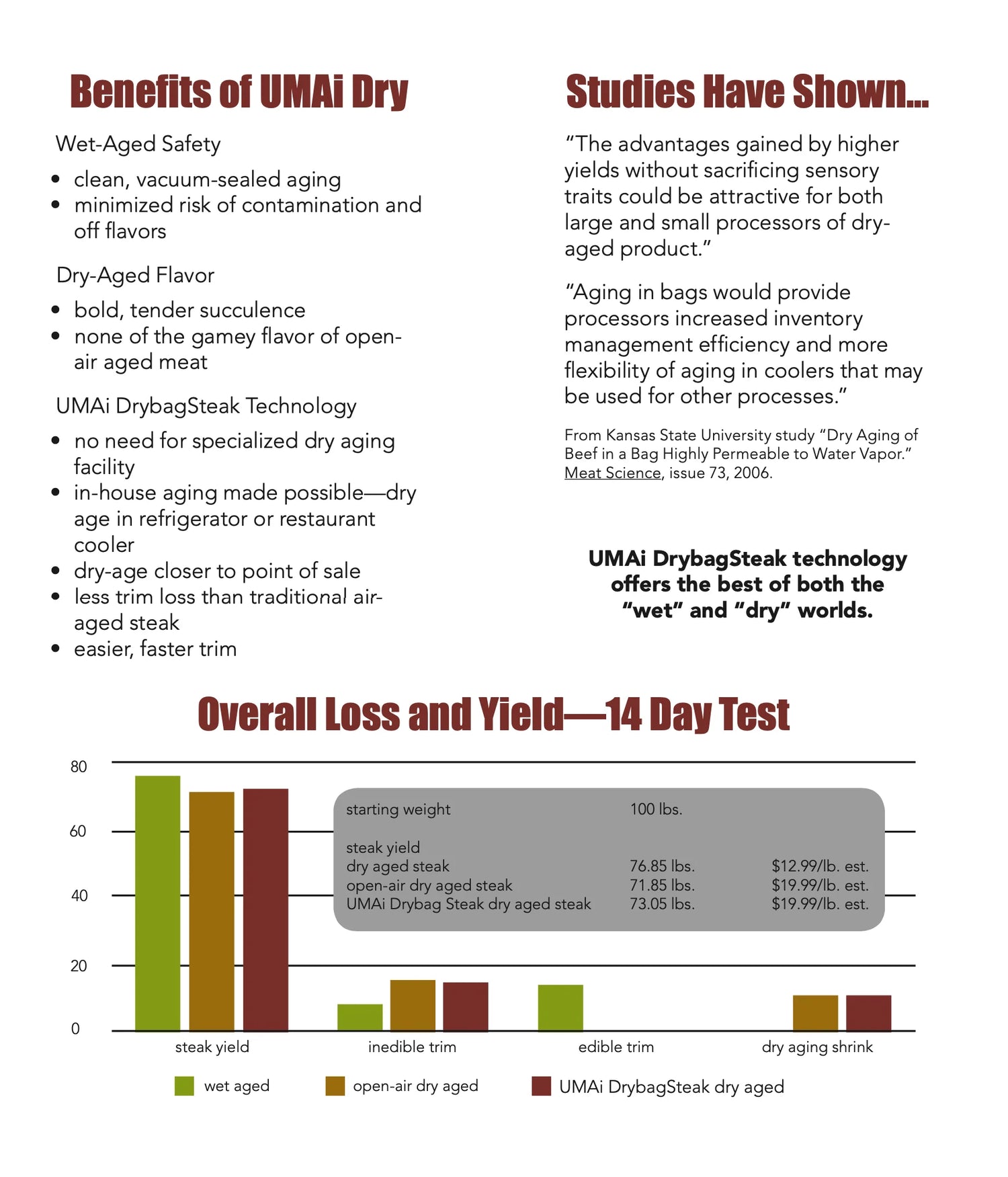
Vacuum-packaged aging of beef typically implies “wet aging”. With much greater than normal moisture permeability, the vacuum-packaged bags in this study may be used to dry-age beef to increase yields, limit microbial contamination, and provide business management efficiencies without affecting product quality….
Kansas State University & Auburn University Study
Effects of Dry Aging of Bone-in vs. Boneless Strip Loins and Two Aging Processes for Two Different Aging Times
Introduction:
“Dry aging is an old-time process that is used to produce a high quality product marketed for high-end customers. Its most unique quality is the distinctive “dry-aged” flavor…."
Abstract:
"The purpose of this experiment was to investigate the combined effects of two dry aging methods (unpackaged and in-the-bag), two loin-cut styles (bone-in shell loins and boneless strip loins), and two aging times (21 and 28 d) on the physical, chemical, sensory, and microbial properties of dry-aged beef….”
Conclusions:
Dry aging in a bag will produce dry aged flavor equal to traditional dry aging. Dry-aged product can be vacuum stored post dry aging without major loss in palatability. Bone-in shell loins have higher yields of dry-aged product than boneless strip loins….
Swedish University, Chinese Academy & Kansas University Study
Consumer Preference and Effect of Correct or Misleading Information After Aging Beef Longissimus Muscle Using Vacuum, Dry Aging, or a Dry Aging Bag
Abstract:
“The objective of this study was to determine which ageing treatment of beef was sensorially preferred by consumers and how their preference changed when given information about the ageing treatment used….”
Conclusions:
“In the two sensory tests in this study, dry aged and bag dry-aged beef are preferred over vacuum aged beef, and a dry-aged label positively influences a consumer’s choice of LTL….”
Swedish University Study
Meat Quality, Microbiological Status and Consumer Preference of Beef Gluteus Medius Aged in a Dry Ageing Bag or Vacuum
Abstract:
“This study investigated meat quality and consumer preference after ageing beef gluteus medius in a water vapour-permeable dry-ageing bag or in vacuum for 14 days….”
Conclusions:
“Dry ageing bag, compared with vacuum ageing, could produce meat with enhanced tenderness and juiciness, characteristics that are valued by consumers. The total weight loss was higher in meat aged in dry ageing bags, despite lower weight loss during thawing and cooking. Thus, the total product yield was lower after ageing meat in dry ageing bags than in vacuum. However, by using dry ageing bags it is possible to produce dry-aged meat under more controlled conditions without negative effects on sensory or other quality attributes.”
Beef Cattle Research 2009
Spotlight on Dry Aging Beef: Effects of Loin Type, Aging Methods, and Aging Time
Introduction:
“Dry aging is an old-time process used to produce a high quality beef product marketed to high-end customers. Its most unique quality is the distinctive dry-aged flavor. Dry aging has been accomplished through many protocols over the years, but an optimum protocol has not been adopted. Practitioners of this art are very interested in providing a consistent, quality, safe product…”
Implications:
- Dry aging in a bag will produce dry-aged flavor and microbial growth equal to that achieved with traditional dry aging.
- Dry-aged product can be vacuum stored post-dry aging with negligible loss in palatability.
- Bone-in shell loins have higher yields of dry-aged product than boneless strip loins.
- Product dry aged for 21 days will have the same flavor profile but less weight loss than product dry aged for 28 days.